By accessing this website, you acknowledge & confirm that you are seeking information relating to Amit Legal of your own accord, without any form of solicitation/advertisement or inducement by Amit Legal or its members. Website content is for informational purposes only and should not be interpreted as soliciting/ advertisement. No material/information provided on this website should be construed as legal advice. Amit Legal shall not be liable for consequences of any action taken by relying on the material/information provided on this website. The contents of this website are the intellectual property of Amit Legal.

Empowering You Through Legal Knowledge
At Amit Legal, we share stories and insights designed to help you navigate legal challenges with confidence and gain clarity in your journey.
2/3/20264 min read
From Chains to Rights: 5 Surprising Ways India Transformed Police Custody
1. Introduction: The Ghost in the Police Station
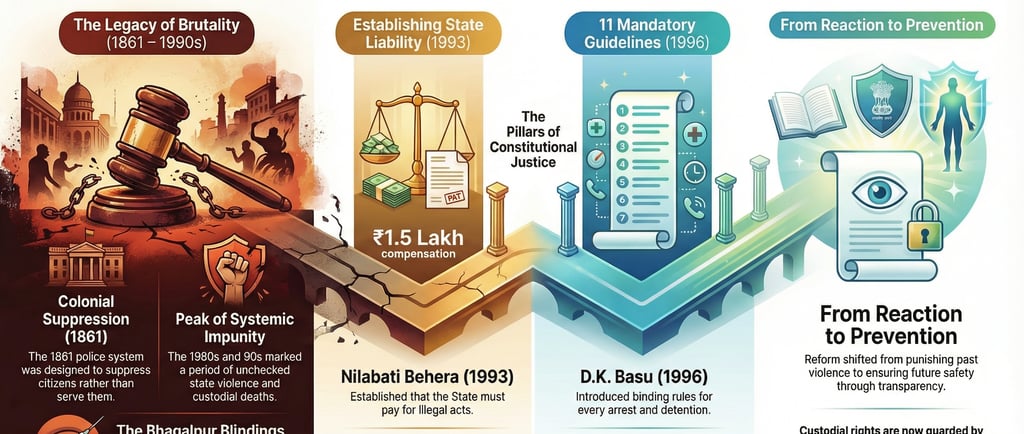
The Indian police system carries a heavy "colonial hangover" that refuses to fade. The Police Act of 1861 was not a framework for public service; it was a weapon of the British Raj, forged not to protect the citizen, but to break the subject. For decades after 1947, this system maintained a "Legacy of Colonial Thuggery," where the police station remained a "black box" of state power. This reached a "Peak of Barbarity" in the 1980s and 90s—exemplified by the horrific Bhagalpur Blindings, a stain on the conscience of the Republic where police used acid to blind undertrials. How did a system rooted in 19th-century suppression evolve into a constitutional service? The journey from chains to rights was sparked not by a politician, but by the unexpected power of a single citizen’s voice.
2. The "Colonial Thuggery" Hangover was Real
The police framework established in 1861 did not vanish when the Union Jack was lowered. Instead, the "thug" mentality persisted for nearly 40 years post-independence, fueled by a deep-seated administrative inertia. This delay in reform was no accident; it was protected by a legal fortress. The state continued to operate under the archaic assumption that the police were a force for control rather than a service for the people. It took the extreme violence of the "Dark Decades"—where custodial deaths and near-total impunity became systemic—to finally trigger a judicial revolution. This "Peak of Barbarity" forced the courts to dismantle the colonial impulses of a state machinery that still viewed its citizens through the lens of the Raj.
3. A Mother’s Letter Can Change the Constitution
The most surprising catalyst for modern Indian law was not a high-priced legal brief, but a simple handwritten letter on plain paper. In the landmark case of Nilabati Behera vs. State of Orissa (1993), the Supreme Court proved that the distance between a grieving citizen and the halls of power could be bridged in an instant.
Suman Behera had been taken into custody in the Sundargarh district of Odisha on a petty theft accusation. The following day, his mangled body was found on railway tracks, bearing unmistakable injuries and clear handcuff marks. His mother, Nilabati, refused to be silenced. She sent a letter to the Supreme Court, an act that triggered the "Heart and Soul" of the Constitution.
The Supreme Court treated Nilabati Behera’s simple letter as a Writ Petition under Article 32, transforming a mother’s private grief into a landmark constitutional crusade for justice.
4. The Death of "Sovereign Immunity"
For decades, the Indian state hid behind the archaic doctrine of "Sovereign Immunity"—the feudal notion that "The King can do no wrong." This doctrine acted as a legal wall, preventing citizens from holding the state liable for the brutality of its officers. The Nilabati Behera verdict finally shattered this shield, ruling that the State cannot claim immunity for the illegal acts committed by its agents.
This breakthrough established three critical pillars of custodial justice:
• The Verdict: The Supreme Court held the State of Orissa directly responsible for the custodial death of Suman Behera, rejecting the "sovereign immunity" defense.
• The Punishment: The court moved beyond words, ordering both departmental and criminal action against the negligent police officials involved.
• The Precedent: Establishing a new "Metric of Justice," the court awarded a compensation of Rs. 1,50,000, creating a binding precedent that the State must pay for the violations of its servants.
5. From Reaction to Prevention: The D.K. Basu Shield
If the Behera case provided a remedy for past blood, the case of D.K. Basu vs. State of West Bengal (1996) was designed to stop the bleeding before it started. Dr. D.K. Basu, Executive Chairman of Legal Aid Services, West Bengal, was haunted by newspaper reports of rampant custodial violence. He directed a letter to the Chief Justice of India, which the court accepted as a Public Interest Litigation (PIL).
Unlike previous cases, this judgment was built on a "Dual Goal":
1. Prevention: Implementing strict guidelines to stop custodial violence before it happens.
2. Remedy: Institutionalizing the right to compensation for victims.
"The purpose is to stop violence and protect human rights." (Manavadhikar ki raksha karna)
This case shifted the focus from individual justice to systemic reform, creating a "procedural shield" to protect the dignity of every arrestee.
6. The 11 Mandatory Rules Every Citizen Should Know
The D.K. Basu judgment did not offer suggestions; it issued Binding Requirements. These 11 rules were designed to "pierce the veil" of the police station, ensuring transparency where there was once only shadow. The "teeth" of this law is simple: any officer who fails to comply faces immediate Contempt of Court proceedings.
The key focus areas of this procedural shield include:
• Visible Identification: Officers must wear clear, visible, and legible name tags and identification during arrest and interrogation.
• The Arrest Memo: A formal memo must be prepared at the time of arrest, witnessed by at least one family member or a respectable local citizen, and counter-signed by the arrestee.
• Right to Inform: The arrestee has an absolute right to have one friend or relative informed of their arrest and the exact place of detention.
• Inspection Memo: At the time of arrest, the officer must record all major and minor injuries present on the arrestee in an "Inspection Memo," signed by both parties.
• Medical Safeguards: Every arrestee must undergo a medical examination by a trained doctor every 48 hours while in custody.
7. Conclusion: The Guardian of the Citizen
The evolution of Indian custodial law marks a profound shift from "Colonial Thuggery" to "Constitutional Service." Through the powerful mechanisms of Writ Petitions and PILs, the judiciary transformed the police from a force of 1861-era suppression into a body bound by the 1950 Constitution. It is a testament to the Republic that a handwritten plea from a grieving mother could become the law of the land, providing a shield for over a billion people.
Yet, as we look back on the progress made since the Bhagalpur Blindings, we must ask: In a system where a single letter once changed everything, what role does the modern citizen play in ensuring these "shields" remain unbroken?
.
Contact
Reach out for legal or educational support
Phone
+91-9304972005
© 2025. All rights reserved.